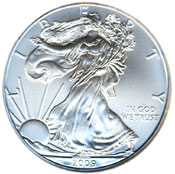
Gold and Silver Eagle Bullion Sales June 2009

The US Mint's sales of gold and silver bullion coins during June 2009 showed increases from both the prior month and year ago levels. The increases came amidst two interesting developments for the US Mint's bullion coin programs.

In the middle of the month, the US Mint announced that their long standing rationing programs would be lifted. Authorized purchasers of bullion coins had been limited in the total number of coins that they could order. This had been cited by many as a sign of the high physical demand for precious metals which would eventually drive prices higher.

Later in the month, the US Mint made the seemingly contradictory announcement that the American Gold Buffalo bullion coin offering would be canceled for 2009. This had been the US Mint's 24 karat gold bullion coin, launched in 2006 as a way of competing with other world mints that produced gold coins with greater fineness than the 22 karat Gold Eagle.

Here's a look at the US Mint's gold, silver, and platinum bullion sales during the month of June 2009. A year to date total appears in the last column.

June 2009 US Mint Bullion Sales

1 oz. 1/2 oz. 1/4 oz. 1/10 oz. Total oz. YTD Total oz.
Gold Eagle 116,000 - - - 116,000 670,000
Silver Eagle 2,245,000


2,245,000 13,824,500
Platinum Eagle - - - - -

Sales of the Gold Eagle were still confined to only the one ounce bullion coin. A total of 116,000 ounces were sold, which was close to double the prior month's sales of 65,000 ounces. This also marks a huge increase from the year ago period when only 15,500 ounces of gold were sold. It's interesting to note that the sales increase comes amidst a down month for gold. Physical gold buyers have tended to increase purchases during period of price decline and curtail purchases during periods of price appreciation.

Sales of the Silver Eagle reached 2,245,000 ounces. This was an increase from the prior month when 1,904,500 ounces were sold and an increase from the year ago period when 1,735,500. With the year now half completed, the American Silver Eagle remains on pace to exceed last year's record sales of 19,583,500 ounces.

Once again, the US Mint did not offer the Platinum Eagle bullion coin in any size.
Gold, Silver & Platinum 2009 Second Quarter Performance

With the second quarter behind us, let's take a look at the performance of gold, silver, and platinum for the second quarter of 2009 and year to date.

All of the metals posted gains, but at single digit levels. The best performer for the second quarter was silver with a gain of 6.33%, followed by platinum with a gain of 5.52%, and then gold with a gain of 1.96%. The closing numbers don't tell the full story. At the beginning of June, precious metals prices had spiked. At this recent peak, silver had been up as much as 22% for the quarter. Platinum and gold were also showing heftier gains at this time.

2009 Second Quarter Gold, Silver, and Platinum Performance

31-Mar-09 30-Jun-09 Change Percent
Gold 916.5 934.50 18.00 1.96%
Silver 13.11 13.94 0.83 6.33%
Platinum 1,124.00 1186.00 62.00 5.52%

On a year to date basis, the top precious metal performer remains as platinum with a gain of 32.07% on the year. This is followed by silver with a gain of 29.19% and gold with a gain of 7.44%. The performance of the metals had lined up in the same manner at the close of the first quarter.

2009 YTD Gold, Silver, and Platinum Performance

30-Dec-08 30-Jun-09 Change Percent
Gold 869.75 934.50 64.75 7.44%
Silver 10.79 13.94 3.15 29.19%
Platinum 898.00 1186.00 288 32.07%

Precious Metals Investment Tax Rates

Gains from the sale of investments in precious metals are currently subject to a tax rate of 28%. This compares to the current long term capital gains rate of 15%, which applies to other investment classes such as stocks and bonds. A bill has been introduced which seeks to tax precious metals investors at the same preferential rates afforded to other investors.

Precious metals investments are considered "collectibles" under the current tax code. Gold, silver, and other precious metals are lumped into the same classification as works of art, rugs, antiques, and stamps. The tax rate for "collectibles gains" is currently 28% regardless of whether the assets were held for more than one year.

The classification as collectibles comes from the section of the Tax Code which describes the capital gains tax rates which apply to different asset classes. This section references a definition of collectibles found in another section of the code, which interestingly provides an exception for certain precious metals. This exception is curiously disregarded for the purposes of capital gains taxation.

The bill S. 1367 Fair Treatment for Precious Metals Investors Act seeks to rectify the disadvantageous tax rates imposed on precious metals investors. The bill would amend the Tax Code to preserve the exception created for certain coins and bullion. After the amendment, common precious metals investments such as American Eagle bullion coins would no longer be classified as "collectibles" and would be eligible for lower long term capital gains rates.

In order to become law, the bill would need to be approved in the House of Representatives, the Senate, and signed by the President. A similar bill was introduced in 2007, but it never gained the support necessary to become law. You can following the progress of the current bill on GovTrack.

US Mint Cancels 2009 American Gold Buffalo Bullion Coins

CoinWorld has reported that the US Mint has canceled the American Gold Buffalo bullion coin offering for 2009. The production of one ounce proof coins for collectors is still planned. This bullion coin program was originally launched in 2006, as the first 24 karat gold bullion coin offering from the United States Mint.

While the majority of the United States Mint's gold bullion sales are derived from the 22 karat American Gold Eagle bullion coins, the Gold Buffaloes still account for a sizable amount of sales. Last year, Gold Buffalo bullion sales tallied 172,000 ounces, while Gold Eagle bullion sales tallied 860,500 ounces.

The Gold Buffalo Coins were also viewed as an offering which allowed the US Mint to compete with other world mints that offer 24 karat gold coins. The US Mint does continue to sell First Spouse Gold Coins minted in 24 karat gold, however, these coins are sold directly by the US Mint at high premiums usually associated with collectors coins. The half ounce gold coins are currently priced at $616 for the uncirculated finish.

News of the canceled bullion coin offering is particularly surprising given the news that the US Mint had ended rationing for other gold and silver bullion coins. This seemed to be an indication that supply constraints were lifting and heavy demand was falling, suggesting a return to normality. Also of note, other world mints are taking steps to expand their bullion coin offerings during this time of increased interest in precious metals.

The cancelation of American Gold Buffalo bullion coins raises many questions, but I doubt reasonable answers will be forthcoming.

US Mint Gold and Silver Rationing Ends

The United States Mint unceremoniously ended the allocation programs which had been limiting the number of Gold and Silver Eagle bullion coins that authorized purchasers could order. The announcement came in the form of a memorandum sent to authorized purchasers on Monday.

June 15, 2009

MEMORANDUM TO ALL AMERICAN EAGLE GOLD AND SILVER BULLION
AUTHORIZED PURCHASERS

SUBJECT: American Eagle Gold and Silver One Ounce Bullion Coin Allocations

Effective immediately, the United States is lifting the allocation process.

You may place your orders under the standard ordering procedures. The ordering minimum and incremental quantities apply.

Thank you for your patience during this past year. We appreciate your continued support.

Amidst high demand for precious metals and a constrained supply of precious metals blanks, the US Mint had implemented allocation programs for Gold and Silver Eagle bullion coins. The allocation program for the American Silver Eagle began on April 21, 2008 when the price of silver was $17.88 per ounce. The allocation program for American Gold Eagle began on August 15, 2008 when the price of gold was $786.50.

The United States Mint had also taken other measures to deal the physical precious metals shortage. First, they had restricted production to only one ounce gold and one ounce silver bullion coin options. Typically a range of fractional bullion coins including 1/2 ounce, 1/4 ounce, and 1/10 ounce coins is offered. Second, they had announced the temporary delay of production for platinum bullion coins and 24 karat Gold Buffalo coins. Third, they delayed the production of gold and silver coins produced for collectors in order to divert all precious metals blanks to the production of bullion coins.

The US Mint has not announced whether production fractional bullion coins, 24 karat gold bullion coins, platinum bullion coins, and gold and silver collector coins has resumed.

Gold Confiscation, Missing Royal Canadian Mint Gold, Bernard von Nothaus Indictment

As gold contemplates the $1,000 barrier, here's a roundup of gold, silver, and precious metals related stories that are interesting for one reason or another. Each headline comes with a snippet of commentary. Enjoy.

A Myth Concerning Gold Confiscation

Examination of a clause in Executive Order 6102, which receives little attention. In addition to the exemption from confiscation for numismatic gold, there was also an exemption for up to five ounces of gold per person.

U.S. Gold, Going or Completely Gone?

According to the United States Geological Survey, nearly 3,000 metric tonnes of gold were exported during 2008 in the form of "gold compounds." Gold compounds consist of products containing gold content such as gold paint. The amount of gold claimed to have been exported in this format is more than 14 times the annual US gold mine production. What is going on here?

Mint can't account for missing gold

In another story about missing gold, an audit of the Royal Canadian Mint turned up a discrepancy between the mint's accounting records and physical precious metals holdings for gold, silver, and other precious metals. The article also describes the largest reported theft from the mint when a machinist pocketed 85 ounces of gold.

Liberty Dollar - Federal Indictment

Bernard von Nothaus, who created an "alternative currency" of gold and silver Liberty Dollars was formally charged "with uttering and passing, and attempting to utter and pass, a coin of silver in resemblance of genuine coins of the United States in the denominations of five dollars and greater, and intended for use as current money". More than a year ago, the headquarters of his company was raided by the federal government and more than two tons of gold, silver, and copper coins were confiscated.

Buffet Gets 'Comeuppance' After Gold Outperforms

Every time someone writes a negative article about gold, they invariable measure the returns since January 1980 to support their preordained conclusion that gold is a bad investment. Someone has finally turned the tables and compared an investment in gold to an investment in Berkshire Hathaway stock since May 2005, a much more favorable investment time frame for gold.

Gold: Headed For a Bubble?

A particularly vacuous article courtesy of the Wall Street Journal. From the title of the article I thought it would at least have some substance, but it turns into another run through of the "risks of buying bullion" and the lack of a measurable intrinsic value. The author winds up the article by suggesting that Treasuries are a preferable safe haven to gold.

Northwestern Mutual Makes First Gold Buy in 152 Years

For the first time in history, Northwestern Mutual, the third largest US life insurance company, has invested in gold. A great quote from CEO Edward Zore, "The downside risk is limited, but the upside is large. We have stocks in our portfolio that lost 95 percent. Gold is not going down to $90.” Indeed.

US Mint Gold and Silver Bullion Sales Through May 2009

As in the past, I wanted to write another post examining the US Mint's monthly gold, silver, and platinum bullion coin sales. Previously these figures were a flawed method of examining demand for physical precious metals due to the rationing program in place from the United States Mint. As long as authorized purchasers of US Mint bullion coins were restricted in the quantities they could purchase, it was difficult to ascertain how much unmet demand existed behind the rationing wall.

However, this month the figures might be closer to providing a useful measure. As I mentioned in several posts this month, a likely combination of decreasing demand and increasing supply has turned the Gold and Silver Eagle shortage to a surplus. For the first time since the rationing programs began, authorized purchasers did not purchase the maximum number of coins allotted by the US Mint.

Here's a look at the US Mint gold, silver, and platinum bullion sales for the month of May 2009, along with a year to date total in the final column.

April 2009 US Mint Bullion Sales

1 oz. 1/2 oz. 1/4 oz. 1/10 oz. Total oz. YTD Total oz.
Gold Eagle 65,000 - - - 65,000 554,500
Gold Buffalo -


-
Silver Eagle 1,904,500


1,904,500 11,579,500
Platinum Eagle - - - - -

There were sales of 65,000 ounces of gold during May 2009. Once again this consisted entirely of one ounce 2009 Gold Eagles, as the US Mint did not offer fractional coins or the 24 karat Gold Buffalo. This was a big drop from the prior month when 147,500 ounces were sold, however it is more than double the number of coins sold in the year ago period of May 2008 when 31,500 ounces were sold.

There were sales of 1,904,500 ounces of silver during May 2009. This was a decline from the prior month when 2,518,000 ounces were sold and a decline, but still up from the year ago period of May 2008 when 1,516,000 ounces were sold. Sales of silver bullion still remain on pace for a record breaking year. The current record was set during 2008 when 19,583,500 ounces were sold for the entire year.

Platinum bullion coins were still not offered for sale by the US Mint. No platinum bullion coins have been offered since November 2008. The US Mint has not provided any additional statements on the status of platinum bullion coins. Notably, the Royal Canadian Mint has been able to produce and sell their Platinum Maple Leaf coins during 2008.

Based on the figures for the gold and silver bullion sales, demand for physical precious metals is apparently dropping significantly at a time when the market prices of the metals seemed to be gaining some momentum. This could be a seasonal impact since prior sales figures show the sales trailing off during the summer months. Or it could be a signal that some buyers are taking pause to see if the much ballyhooed "green shots" actually take root or whither up and die.

Disclosure: Long physical gold and silver